Glory O’Brien’s History of the Future by A. S. King

A. S. King is the literature equivalent of a mad scientist.  She puts together plots and themes that should never be mixed, but…VOILA.  A masterpiece!  Did I just mix metaphors and make her an artist?  Whatever!  She is a scientist, artist, author–everything and nothing.  Just like Glory.

It takes a special book to deal with the general doubts and fears of a teenager, plus the specific doubts and fears of a teenager who’s mother committed suicide, within the context of visions brought about by petrified bat-beer.  Yes, you read that correctly.  It’s super weird, but somehow it all works together brilliantly.  It almost doesn’t matter whether the bat-visions are true; the pictures Glory sees of the past and the future give her the courage to live in the present.

Can I say, though, how much I love that Glory’s visions of a hellish future of civil wars and nuclear explosions are the result of anti-feminists?  I might have gleefully clapped my hands when I realized King had written a post-apocalyptic novel to inspire readers to give women equal rights.  The visions were all-around spectacular; I was amazed at the detail and scope of people’s ancestors and descendents.

All this sounds strange, and it is.  But within this bizarre plot are some really poignant messages of grief, of learning to communicate and maybe move on.  There’s a wonderful depiction of a dying friendship, with all the frustrations and promises and confusion such a relationship entails.  And at the heart of it all, there’s Glory, a girl scared she’s doomed to die.  Ironically, it’s by seeing her death that she learns how to live.

Book Jacket 81b37cd4781fd48e525165ce7bd85f6f
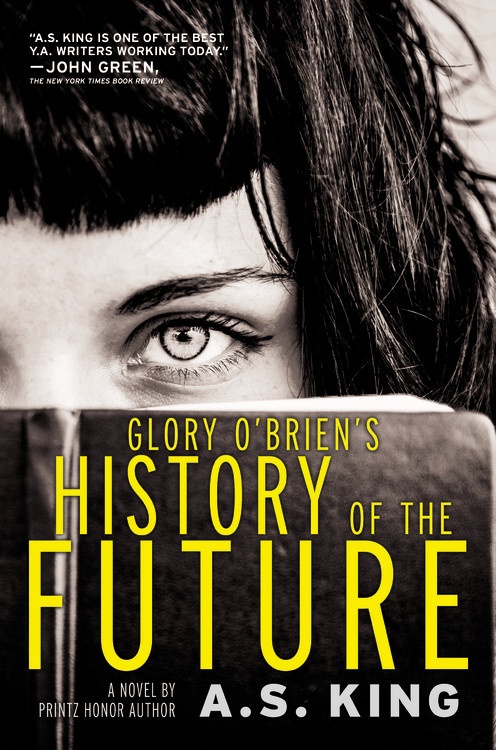
Graduation is usually a time of limitless possibilities, but not for Glory.  She’s never stopped wondering whether her mother’s suicide will lead her to end her own life someday, as statistics would predict.  But everything changes after a transformative night when she gains the power to see anyone’s infinite past and future.  And what she sees ahead for humanity is terrifying.

Glory makes it her mission to record everything that’s coming, hoping her notes will somehow make a difference.  She may not see a future for herself, but she’ll do anything to make sure this one doesn’t come to pass.

With astonishing insight and arresting vision, Printz Honor author A. S. King tells the epic story of a girl coping with devastating loss at long last–a girl who has no idea that the future needs her, and that the present needs her even more.

Release Date:  October 2014

Want another opinion?  Check out reviews by The New York Times and The Librarian Who Doesn’t Say Shhh!
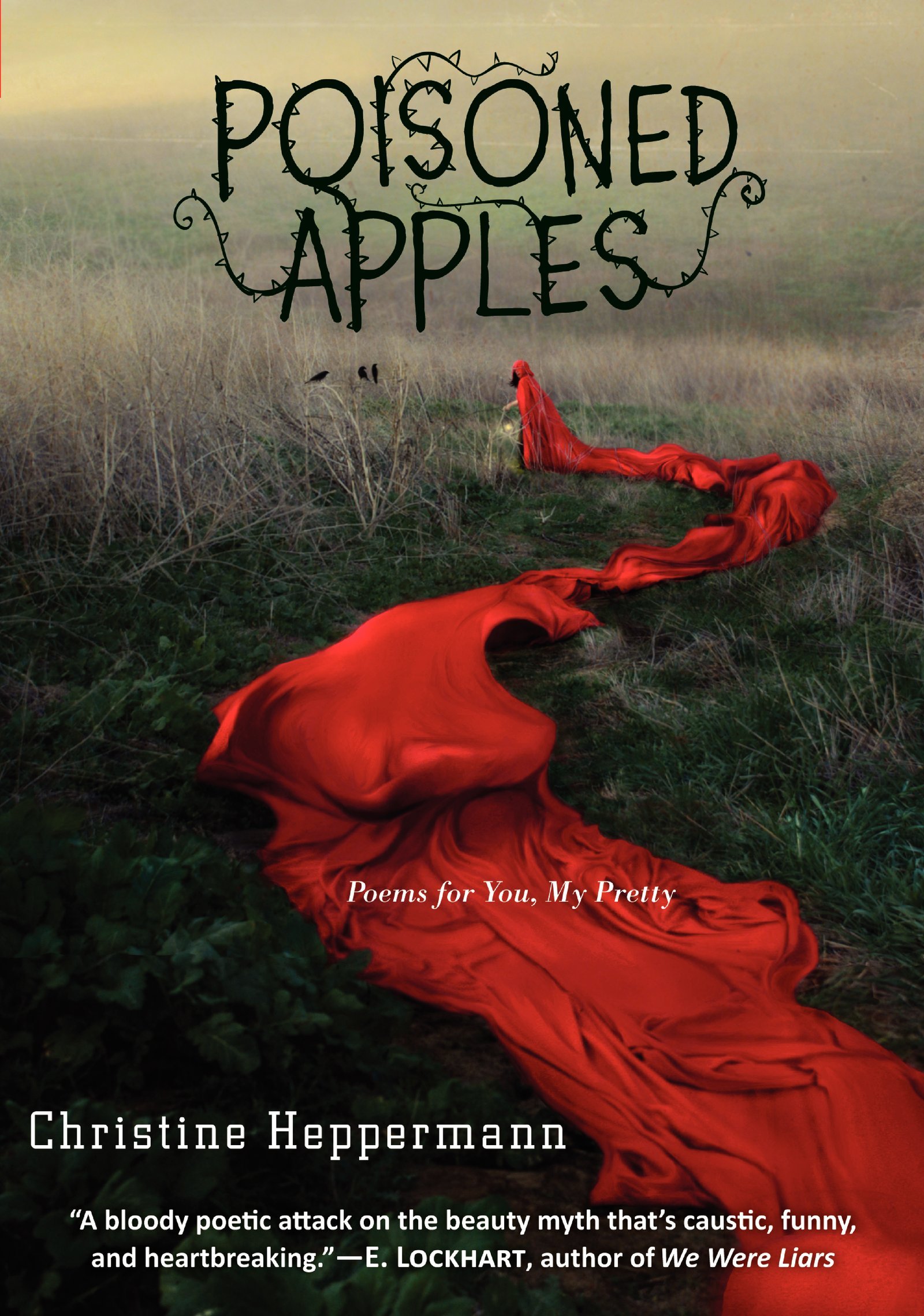
Poisoned Apples by Christine Heppermann

Wow.  I never knew I needed a book that addressed the complexities of growing up female through the lens of poetry based on fairy tale tropes, but this book satisfied a deep part of me.  The topics are sometimes uncomfortably difficult, but then, so are stories of witches eating children.   The best way to advertise this amazing collection is to let it speak for itself–here is one of my favorite poems, “Blow Your House In.”

She used to be a house of bricks,
point guard on the JV team, walling out
defenders who could only huff and puff
and watch as the layups roll in.

She traded for a house of sticks,
kindling in Converse high-tops and a red Adidas tent.
At lunch she swirled a teeny spoon in yogurt
that never touched her lips and said
she’d decided to quit chasing a stupid ball.

Now she’s building herself out of straw
as light as the needle swimming in her bathroom scale.
The smaller the number, the closer to gold,
the tighter her face, afire with the zeal of a wolf
who has one house left to destroy.

Book Jacket poisoned-apples-cover

Once upon a time…you were a princess, or an orphan.  A wicked witch, fairy godmother, prom queen, valedictorian, team captain, Big Bad Wolf, Little Bo Peep.  But you are more than just a hero or a villain, cursed or charmed.  You are everything in between.  You are everything.

In fifty poems, Christine Heppermann places fairy tales side by side with the modern teenage girl.  Powerful and provocative, deadly funny and deadly serious, this collection is one to read, to share, to treasure, and to come back to again and again.

Release Date:  September 2014

Want another opinion?  Check out reviews by Teenreads and Elle.

Arwen and Tauriel

Me:  And I loved Tauriel and Kili.
David:  Of course you did.
Me:  I was expecting her to die with him, since she’s not in Lord of the Rings.  I thought it would be a tragic Romeo & Juliet thing.  But she lived!  And it was so much worse and so much better!
David:  She has to live without him forever.
Me:  Yeah.
David:  Forever.
Me:  Oh my gosh.  You’re right.  *keening*  This is so painful!!
David:  She’s like the opposite of Arwen.
Me:  *gasp*  Someone should write an essay about that!
David:  I’ll get right on that.

I don’t think he’s going to get right on that, so I will!  Tauriel, the immortal elf who loved a mortal dwarf, and Arwen, the immortal elf who loved a mortal man.  The first watched her love die and will have to live forever with that pain, while the second gave up her immortality and died with her love.  Although Arwen’s decision was given much weight throughout the LotR series, I can’t help but think that Tauriel’s love is the more tragic.

Arwen’s choice to give up her immortality and live a mortal life alongside Aragorn was undercut by the overarching tragedy of the elves.  They live forever, but in a broken world, this is not such a gift as it might seem.  Some elves respond to this tragedy by isolation (Thranduil and the Mirkwood elves), while others jump into the affairs of men and suffer the consequences (Haldir in the movies).  In between are those like Elrond and Galadriel who spend most of their time amongst their own people, but are willing to engage with the wars of men and dwarves if the need is great enough.  No matter their worldview, the elves are consistently portrayed as beautiful tragedies, a relic of a time long gone.  They are separate from everything around them, waiting for the end of their age when all elves journey on to Valinor.

With this backdrop, Arwen’s decision feels almost smart.  Choosing to live and die a mortal means becoming relevant.  She can engage with the peoples around her and feel the increased joy and sorrow that accompanies experiences from a mortal vantage point.  Eternity for elves is known, but the fate of men after death is less established.  This is one of her risks, trusting in eternity even without the surety of elven faith.  Far greater, however, is her separation from her people.  As her father and friends leave Middle-earth, she alone lives on.  Until she dies.  But it seems to me that death is not so much the tragedy as is her goodbyes.

Then we have Tauriel, a new character added by Peter Jackson.  I adore her, both for the general inclusion of a female presence in the male-dominated Hobbit story, and for her specific combination of warrior-lover.  Kili the dwarf falls in love with her when she saves his life, and she falls in love with him when they discuss starlight and family traditions.  Although they know each other an impossibly short amount of time, Tauriel feels his death deeply.  So deeply that she finally comes to understand the coldness of Thranduil, who repressed his emotions so deeply in order to ignore the pain of losing his wife centuries ago.

And that’s the thing.  Losing someone you love means centuries of grief if you are an elf.  As in Thranduil’s case, this can still occur even between elf-elf reltionships.  But Tauriel’s love for a dwarf exacerbates this problem.  Not only is she in love with a mortal, she is in love with a hot-headed dwarf who seeks the glory of battle and the honor of his homeland.  A short time together, she now has an eternity to mourn him.  No wonder she cries, “If this is love, I do not want it.”  Opening your heart to love means opening your heart to pain.  For a human, but so much more for an elf.

So who has the greater tragedy?  Arwen, who gave up immortality, or Tauriel, who must live forever with grief?

Clearly the answer is me, a obsessive fan who has chosen to carry both their burdens.