Glory O’Brien’s History of the Future by A. S. King

A. S. King is the literature equivalent of a mad scientist.  She puts together plots and themes that should never be mixed, but…VOILA.  A masterpiece!  Did I just mix metaphors and make her an artist?  Whatever!  She is a scientist, artist, author–everything and nothing.  Just like Glory.

It takes a special book to deal with the general doubts and fears of a teenager, plus the specific doubts and fears of a teenager who’s mother committed suicide, within the context of visions brought about by petrified bat-beer.  Yes, you read that correctly.  It’s super weird, but somehow it all works together brilliantly.  It almost doesn’t matter whether the bat-visions are true; the pictures Glory sees of the past and the future give her the courage to live in the present.

Can I say, though, how much I love that Glory’s visions of a hellish future of civil wars and nuclear explosions are the result of anti-feminists?  I might have gleefully clapped my hands when I realized King had written a post-apocalyptic novel to inspire readers to give women equal rights.  The visions were all-around spectacular; I was amazed at the detail and scope of people’s ancestors and descendents.

All this sounds strange, and it is.  But within this bizarre plot are some really poignant messages of grief, of learning to communicate and maybe move on.  There’s a wonderful depiction of a dying friendship, with all the frustrations and promises and confusion such a relationship entails.  And at the heart of it all, there’s Glory, a girl scared she’s doomed to die.  Ironically, it’s by seeing her death that she learns how to live.

Book Jacket 81b37cd4781fd48e525165ce7bd85f6f
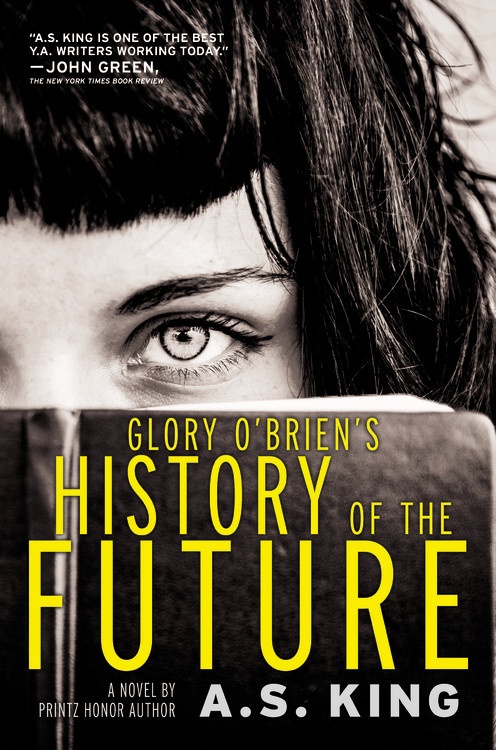
Graduation is usually a time of limitless possibilities, but not for Glory.  She’s never stopped wondering whether her mother’s suicide will lead her to end her own life someday, as statistics would predict.  But everything changes after a transformative night when she gains the power to see anyone’s infinite past and future.  And what she sees ahead for humanity is terrifying.

Glory makes it her mission to record everything that’s coming, hoping her notes will somehow make a difference.  She may not see a future for herself, but she’ll do anything to make sure this one doesn’t come to pass.

With astonishing insight and arresting vision, Printz Honor author A. S. King tells the epic story of a girl coping with devastating loss at long last–a girl who has no idea that the future needs her, and that the present needs her even more.

Release Date:  October 2014

Want another opinion?  Check out reviews by The New York Times and The Librarian Who Doesn’t Say Shhh!

How to Keep Your Sanity on a Solo Road Trip

I have high standards for road trips.  For one thing, I will only call something a road trip if it would be extremely uncomfortable to go both there and back again in one day.  Five hours?  That’s an afternoon drive.  I tend to reserve the title “road trip” for car journeys at least seven hours long.  This is completely arbitrary and totally dependent upon the fact that I went to college seven hours from my hometown.  However, now that I live thirteen hours from my hometown and have made that trip alone three times, I like to think I’m an expert.  Here are some tips for making solo road trips bearable: 

    1. Don’t Go Solo.  I know, I know.  The whole point of this list is that you’re driving alone.  But if there is any way to bring a friend with you, do it.  Don’t be a martyr.  Having someone else in the car means entertainment, but more importantly, it means you can nap while they drive.
    2. Wear Comfortable Clothes.  You’re alone.  You’re mostly going to be stopping at gas stations where everyone looks their worst.  So wear both sweatshirts and sweatpants.  Leave off makeup and pile your hair on top of your head.  Wear slippers, even.  You’re going to be sitting still for hours and hours–be as comfortable as possible.
    3. Stock up on Podcasts.  I’ve recently gotten into podcasts, and they are a fantastic way to kill an hour or so on the road.  I’ve been really into YouTubers turned Podcasters Grace Helbig (“Not Too Deep”) and Rhett and Link (“Earbiscuits”).  If that’s not your style, check out Stuff’s post on the 15 Best Podcasts of 2014.
    4. But Mostly Audiobooks.  Podcasts only last an hour, so for a really intense road trip, you’re going to need something longer.  Thankfully, there are audiobooks, which often last up to 14 hours!  If you get a really good story, this can make the time fly by.  I like to listen to books I’ve already read, which allows me to keep my primary focus on the road.  Best road trip audiobooks:  The Hunger Games series by Susanne Collins.  They never get old, and they are always riveting.
    5. Create Caffeine Games.  Obviously you’re going to need a lot of caffeine to make it through the day.  Why not keep your brain occupied by trying to find diverse ways to caffeinate yourself?  Start with homemade coffee in a thermos, then stop for soda, or gas station energy drinks, or drive through Starbucks.  Don’t let yourself do the same drink twice!
    6. Eat in the Car.  I once traveled with a friend who insisted on stopping to eat inside fast food restaurants.  And I mean, I guess this allows for some peace and the ability to zone out, but what a waste!  All I could do was count how many minutes we were wasting by sitting a building rather than in my car.  This is, actually, one of the benefits of traveling solo.  You can do what you want!  And I always want to drive through (never Arby’s, those lines are too long) and eat while I’m driving.  Combining activities makes me feel incredibly productive.
    7. Call Those Friends You’ve Been Ignoring.  I always choose to text people over calling them.  But sometimes it’s nice to catch up with friends or family via a verbal conversation.  I’ll never do it during real life, but stuck in a car for hours?  Phone calls start to look appealing.
    8. Create a “Middle School” Playlist.  Singing in the car is a no brainer.  But around hour two, I start to get tired of whatever band I’m currently loving.  It’s during times such as these that you need to break out your “Middle School” playlist, full of all your old favorites–those songs you haven’t thought about in a decade but know every lyric once it’s playing.  My playlist has a lot of N*SYNC, Smashmouth, and Counting Crows.
    9. Take Back Roads. This is not great advice if time is of the essence.  When you’re in a hurry, interstates are your best bet.  But if you find yourself taking the same long road trip every few months, why not change things up and find a back road or two?  You’ll be amazed at how having actual scenery will keep you interested and entertained.
    10. Take Multiple Days.  Know your limits.  If you can’t do fourteen hours in one day, split it up and book a hotel.  Staying at a hotel alone is its own kind of fun.

How do you survive long car trips?  Do you have a travel tip that I missed?  Comment and let me know!

Creativity on the Internet

I have spent the last couple months obsessed with YouTubers.  In three days I plan to post a list of my favorite vloggers and Internet performers, but for now, I want to take a few steps back and look at creativity in general and how it is expressed online.

Ear Biscuits is a podcast by YouTubers Rhett and Link.  Together they interview interesting people on the Internet, going deep in discovering what makes these successful YouTubers tick.  The men and women who have sat at their Round Table of Dim Lighting include John and Hank Green, PewDiePie, Smosh, and the Holy Trifecta:  Grace Helbig, Mamrie Hart, and Hannah Hart.  These are men and women who have millions of subscribers to their channels.

During their interviews, Rhett and Link cover family pasts, careers and hobbies, and how people became the Internet sensations that they are today.  Most of the people they interview make enough money in creating videos that YouTube is their full-time job.  After listening to thirty or so interviews, I’ve put together a few common denominators that I think influence how creative people successfully become Internet famous.

maxresdefault

Most of the YouTube elite have some kind of family trauma in their past.  This is not entirely surprising, since creative people often feel the need to express themselves because their earliest selves were not able to do so adequately.  At the same time, the way people spoke of divorce and mental illness was from a place of resilience.  They took the pain they felt and turned it into something else–something funny or educational or meaningful.

There is also a trend of YouTubers being introverted or shy; many sheepishly talked about having few friends growing up.  The Internet is a perfect place for people who deeply crave attention and affirmation while also wanting safety and distance.  Content creators can express themselves and be vulnerable with the safety of a screen between them and their audience.  The quietest people sometimes just need a safe outlet for them to truly shine and become outgoing.

I should clarify, these trends stood out to me, but by no means has every YouTuber had a traumatic past or been introverted.  Many had loving childhoods and were extremely outgoing.  But it did seem that the YouTubers interviewed seemed disproportionately unique in their personalities and pasts.

Nearly all of those I heard interviewed began making videos within the first couple years of YouTube’s existence in 2006.  They created videos because they wanted to.  That they later developed an audience was unintentional.  Almost unanimously, these vloggers and performers had a genuine love for creating.  They made content because it was going to spill out of them whether or not they had a platform.  It was after one of their videos went viral and their subscribers drastically jumped that they had to reconsider what exactly they were doing.

And that is the final piece of the puzzle.  Although most of the men and women interviewed did not start creating videos in order to get famous, once they accumulated a following, they had the business acumen to create a brand and sell it.  They became more intentional about what they made, and they expanded their brand across media platforms.  Some branched out and created merchandise, or charity drives, or wrote books.  All of them continued to be passionately creative, but now they had a bit more focus.

Why does this matter?  Well, internalizing these YouTubers’ stories was what inspired me to combine my blogs.  I have been blogging for over twelve years, from Xanga to Blogger to WordPress.  I create because I have to, but in the last month or so I decided I wanted to be more intentional about it.  I don’t think I will ever have the influence of Rhett and Link or Grace Helbig, but I want to be the best blogger I can be.  Although we’re in different realms of the Internet, I’ve learned a lot from YouTubers, and I hope to continue to be inspired by their stories.

Coming up:  My list of favorite YouTubers!

How do you think people express their creativity on the Internet?  What are the necessary pieces to someone’s Internet success?  Comment and let me know what you think!

Oishii! Japanese Food for the Sushi Averse (Guest Post)

Elizabeth Waibel is a friend from college who became even closer after we graduated.  We share a love of literary analysis, snarky humor, and now, the country and culture of Japan.  She currently works as a journalist for The Gazette in Maryland.

I did not particularly want to go to Japan. My limited experience in sushi restaurants that smelled like seaweed did not earn it the same place on my travel priorities list as those countries famous for crisp baguettes or cappuccino, and I have never been a fan of rice.

“They eat tepid fish!” I complained to my sister in between looking for plane tickets, which were unjustly more expensive to Japan than to places known for pasta and cheese.

My best friend has lived in Japan since 2011. For about a year, ever since I realized she wasn’t coming back, I had been promising to visit. So, prodded by the thought that few are so lucky to have a friend in such an interesting place and reassured by the thought that, if necessary, I could live off tempura (breaded and deep-fried shrimp or vegetables) for a week, I brushed up my chopsticks skills and booked a knee-numbing flight to Tokyo.

In retrospect, it was horribly unfair to judge an entire country on which of its dishes had happened to make their way to suburban America. There is so much more to Japanese food than sushi, and I could have happily spent at least two more weeks exploring the flavors and ingredients of a cuisine almost entirely new to me.

So, whether you are planning a trip to Japan or are tired of faking a fish allergy to avoid sushi restaurants with friends, here area few Japanese food recommendations that do not involve raw fish:

1. Tonkatsu – A breaded and fried slice of pork often served with rice, cabbage, and a delicious sauce that (to this American) tastes similar to teriyaki. Recommended for fans of cornflake chicken or schnitzel.

2. Ramen – This is NOT the same as the 20-cent instant noodles you ate in your dorm room, although you can buy things like that in Japan too. One of my favorite things I ate in Japan, ramen is a soup of wheat noodles in a savory broth topped with things like pork, bean sprouts, onions, and a boiled egg. It was oishii (delicious)!

3. Okonomiyaki – Cabbage is mixed with a simple, smoky-flavored egg and flour batter and fried into a thick, savory pancake. Then, it is brushed with a sweet and smoky sauce and topped with bits of dried, smoked fish that seem to be Japan’s answer to bacon bits. Okonomiyaki often has other ingredients mixed in, such as shrimp and noodles. Some restaurants in Tokyo also serve monjayaki, which resembles a goopy stir-fry and tastes like a comfort-food casserole. I recommend trying the kind with cheese.

4. Kakigori – This is basically a gourmet sno-cone. Kakigori is shaved ice that can be topped with strawberry (ichigo) syrup and condensed milk or, for those seeking more uniquely Japanese flavors, green tea syrup, red beans and mochi (rice paste). Ichigo kakigori with milk served with hojicha (green tea whose leaves have been smoked) might have been the best thing I ate in Japan.

If you ever do make it to Japan, be sure to get food at one of the many conbinis, or convenience stores. Food at the 7-Eleven in Japan is wildly better than food at the 7-Eleven in America. You can get a wide selection of refrigerated lunches, drinks and fun snacks. I also recommend visiting a place that sells sushi (preferably the cooked kind) on conveyor belts that run past all the tables, delivering a steady line of food. This is the future of dining.

So yes, there is more to Japanese food than sashimi, and it is possible to visit there for a week or more without eating tepid fish. Enjoy!

IMG_1222

Me (right) and my friend enjoying iced coffee from a cobini on the shinkansen, or bullet train.

IMG_1288

The culinary genius behind my first Japanese ramen experience.

Keep up with Elizabeth via her Twitter account, @lizwaibel.  I suggest you also look into Ishinomaki Christian Center if you’d like to donate to an organization that supports community rebuilding efforts after the 2011 earthquake and tsunami.

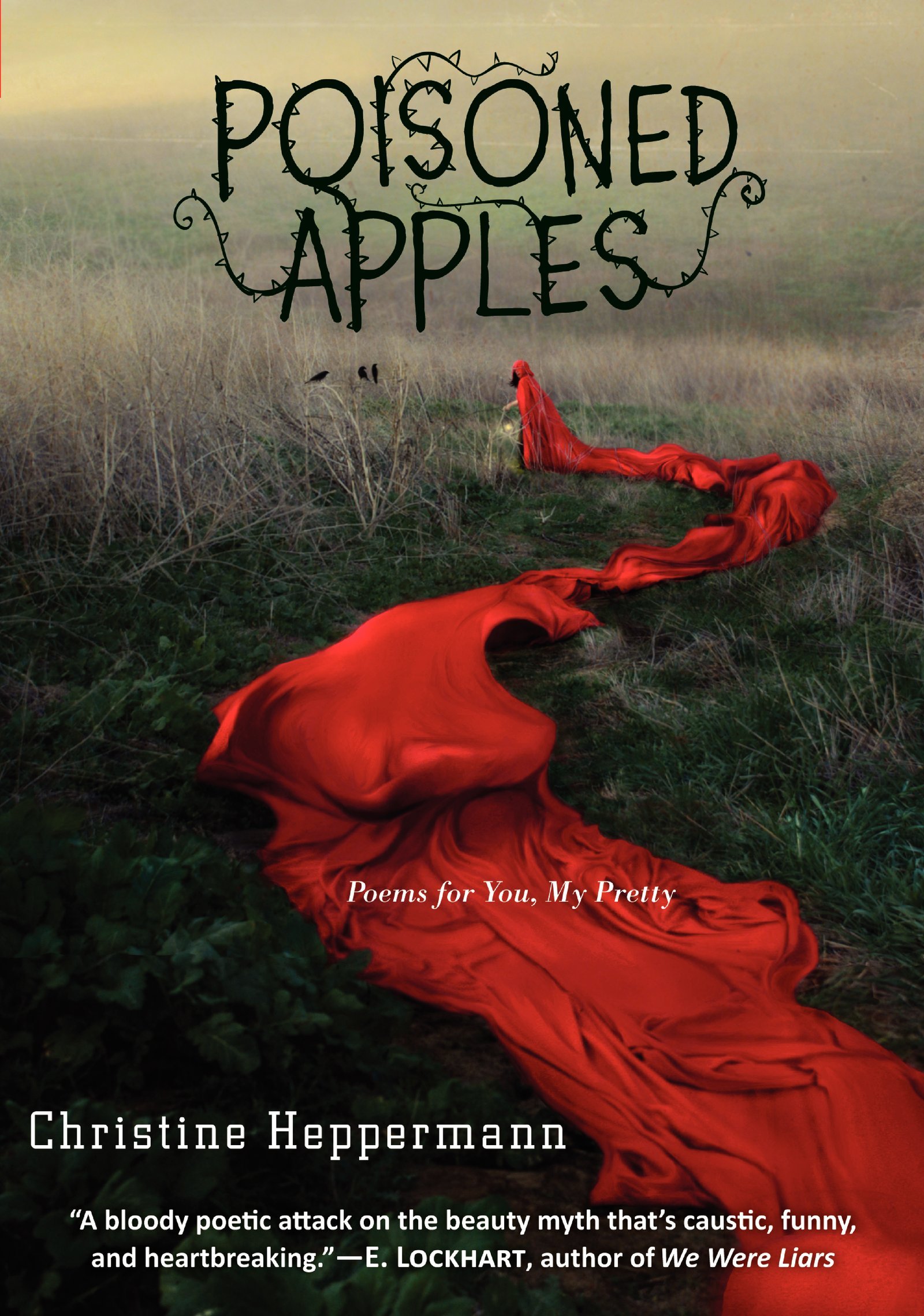
Poisoned Apples by Christine Heppermann

Wow.  I never knew I needed a book that addressed the complexities of growing up female through the lens of poetry based on fairy tale tropes, but this book satisfied a deep part of me.  The topics are sometimes uncomfortably difficult, but then, so are stories of witches eating children.   The best way to advertise this amazing collection is to let it speak for itself–here is one of my favorite poems, “Blow Your House In.”

She used to be a house of bricks,
point guard on the JV team, walling out
defenders who could only huff and puff
and watch as the layups roll in.

She traded for a house of sticks,
kindling in Converse high-tops and a red Adidas tent.
At lunch she swirled a teeny spoon in yogurt
that never touched her lips and said
she’d decided to quit chasing a stupid ball.

Now she’s building herself out of straw
as light as the needle swimming in her bathroom scale.
The smaller the number, the closer to gold,
the tighter her face, afire with the zeal of a wolf
who has one house left to destroy.

Book Jacket poisoned-apples-cover

Once upon a time…you were a princess, or an orphan.  A wicked witch, fairy godmother, prom queen, valedictorian, team captain, Big Bad Wolf, Little Bo Peep.  But you are more than just a hero or a villain, cursed or charmed.  You are everything in between.  You are everything.

In fifty poems, Christine Heppermann places fairy tales side by side with the modern teenage girl.  Powerful and provocative, deadly funny and deadly serious, this collection is one to read, to share, to treasure, and to come back to again and again.

Release Date:  September 2014

Want another opinion?  Check out reviews by Teenreads and Elle.

Blog Rec – Nomadic Matt

Nomadic Matt is an incredibly popular travel blogger.  He’s been all over North and South America, most of Europe, and a good chunk of Asia.  He writes thoughtful pieces on travel in general as well as tips for traveling in specific countries for cheap.  It’s a great combination of information and entertainment, and spending more than five minutes on his blog will leave you with a serious case of wanderlust. 

I especially loved his post, “Everyone Says I’m Running Away.”  It is a beautifully written piece in response to comments about traveling being a form of running away–from responsibility, from adulthood, from whatever.  Traveling is about escape, yes, but not necessarily running away from all of life.  It’s running away from a certain kind of life.  Matt puts it this way:

People assume that we are simply running away from our problems, running away from “the real world.”

And to all those people who say that, I say to you?—?you’re right.

Completely right.

I am running away.

I’m running away from your idea of the “real” world.

I’m avoiding your life.

And, instead, I’m running towards everything – towards the world, exotic places, new people, different cultures, and my own idea of freedom.

Preach it, Matt.  Prepare to lose hours of your life exploring his blog, but don’t stop there!  Plan a trip!  Go see the world for yourself!  And use his blog to help you do it.

Gifts of SIngleness: Use Them or Become Resentful

While I was trying to decide whether to stay in Dallas after I graduate from DTS or else move to Athens, my biggest Dallas advocates were repeating the same variety of advice:  Settle down.  Start investing in long term 1) relationships, 2) career, 3) housing.  Stop running.  These messages were internal, too.  After all, I’m 26-years-old, and Facebook is full of my peers marrying, buying houses, and even creating the next generation of adorable little girls and boys.  Picking up and moving overseas is such a post-college phase (and, uh, coincidentally, exactly what I did post-college).  A phase you’re meant to grow out of, right?

I felt vaguely guilty about my decision to choose Athens over Dallas despite feeling deep in my bones that it was the best choice and that it was where God was uniquely calling me.  That guilt disappeared during a conversation with my friend Jennie.  She affirmed my decision, then said, “It’s so great that you can just decide to move halfway around the world.  I have a hard enough time [taking her four children] into town to buy groceries.”

Suddenly things made a little more sense; stability and security are wonderful things, but so are freedom and adventure.  The former are more easily acquired through marriage, while the latter tend to find expression in singles.  This is, obviously, overly simplistic.  Singles can be stable and marrieds can have adventures.  But generally, I think this division is fairly accurate.

I have a long and varied relationship with my own singleness.  Sometimes I am desperate to be married, and other times I want to run as far away from the possibility as I can (these mood swings often coincide with the health or destruction of my friends’ relationships).  I have felt the cultural and Christian pressure that implies I am “less than” because I am single.  I have also felt the warmth and inclusion of marrieds and singles who welcome me into their homes and lives.  I used to think that being single was essentially a waiting game; over the years I have started to embrace my singleness and see it as the gift that it is.

I have more time to myself, more creative energy, a greater ability to serve others.  I can make decisions without aligning my plans to someone else’s, and I can be spontaneous in a way my married friends (especially those with children) simply cannot.  In short, as a single woman, I have more freedom and adventure.

So back to those itching thoughts about security and settling down.  Talking with Jennie, I realized that in many ways, I was hearing the message “Act like a married person.”  Having described the benefits of being single, I’ll now say I think the benefits of marriage are primarily security and stability (relationally, vocationally, and geographically).  I was being told to value the gifts of marriage above the gifts of singleness.  And subconsciously, I had started to agree.

Now that the subconscious was conscious, my anger flooded in.  No way was I going to feel bad about being single!  No way was I going to agree with societal pressure.  If I get married some day, and I hope I do, I will pursue and enjoy the gifts of stability and security.  Until then, I intend to embrace the gifts of singleness–I want to pursue freedom and adventure.  I want to be spontaneous, to use my nomadic ability to travel the world and connect with a vast network of amazing people.

Not that all single people need to travel in order to feel self-actualized.  But I do think that single people need to look at their life situation and seek out opportunities for freedom and adventure, whatever that may look like for her or him individually.  If single people do not take advantage of these gifts and instead pursue security and stability exclusively, I think we will become resentful.  I did, when I imagined my life in Dallas, living in the same place, working in the same place, year after year after year…alone.  I have seen this happen to single men and women–they get so locked into finding a good job and buying a house that they then obsess over finding the missing piece:  a husband or wife to complete the set.

I don’t want to become so focused on what I don’t have that I forget to appreciate what I do have:  the ability to relate broadly and meaningfully with many people, the freedom to be spontaneous, and an adventurous spirit that says “yes” before “let me check with so-and-so.”  I want to love being single while I’m here, for as long as that might be.  Deciding to move to Athens has renewed my ability to embrace my singleness.

Sia’s Dance Videos

For the last couple months, it’s been an unspoken rule that the second I find “Chandelier” on the radio, everything else in my car becomes non-existent.  Ketan once stopped mid-sentence, said, “Oh no,” waited as I scream-sang for 3 minutes and 52 seconds, then picked up where he had left off.  I loved the song’s unflinching awareness of self-harm as a coping strategy and the hidden pain of those we think are on top of the world (see also Tove Lo’s “Habits”).  The unapologetic message, “This is what I have to do to make it through the day, but I know it’s not really working” is hugely appealing to me.

And then I saw the music video, and my love exploded through the roof.

I mean, first, the choreography is amazing.  Maddie Ziegler is an extremely talented young dancer whose graceful chaos is both attractive and disturbing.  She is aggressive, confused, childlike, crazed, powerful, weightless, and silly.  She is the cacophony of humanity, the riot of emotions that refuse to be categorized or systematized.  She is too much–too much for her past, for enforced societal roles, for what she wants or what she fears–you can read a lot of things into this dance, which is what makes it so powerful.  What is clear is that she’s cramming herself smaller, flying and screaming before ending with a perfect curtsy, one that continues for an uncomfortably long time as she forces us to bear the weight of her strained grin.

Perfection.

A couple days ago I saw Sia had a new music video, this one to a song called “Elastic Heart” which I know nothing about.  That lends a weird quality to my appreciation of the video, since I’m judging it entirely on the dance and pretty much ignoring the lyrics.

There is an immediately obvious difference–Maddie Ziegler is joined by Shia LeBeouf.  After an initial squick of “the prepubescent girl and adult man look naked!” I was immediately overwhelmed by how perfect the skin-toned outfits are.  Never once is either dancer sexualized, though it would have been easy to let the tone slip somewhere inappropriate.  Instead, the implied nudity is all about vulnerability.  Maddie and Shia are laid bare to the public, ripped open beyond skin to the uncomfortable pain that lies beneath.  The dirtied coverings perfectly convey the discomfort of being exposed without once being about sex.  Brilliant.
When I first watched the video, I viewed it through the lens of a relationship, since I’ve been trained to think of any female/male interaction as necessarily romantic.  I liked that narrative, but then I saw Sia’s tweets about how Maddie and Shia represent two “Sias.”  I watched it again, and I love this.  I love it so much.

Alluding to Carl Jung’s theories of each person containing both anima and animus forces (feminine and masculine),  this video delves into warring aspects of self.  The two circle each other, fight, retreat.  In a moment of tenderness, it seems like there could be reconciliation, but the wild one lashes out in fear.  The other becomes angry until it is clear that the wild one is free.  In the cage, the two selves can fight in freedom and even safety.  But now there is disparity–one can grow up and leave the other behind.  In a last bid for unity, she re-enters the cage, drugs and tricks him into following her out, but to no avail.  We cannot grow up without leaving some parts of ourselves behind.  We cannot embrace one role without neglecting another.  And so we’re left for nearly 50 interminably silent seconds to watch them fail to free him.  Holy goosebumps.

I’m a huge fan of story-telling, but my obsession with words often makes me forget how powerful the medium of dance is for conveying emotion.  Thank goodness Sia is around to remind me of its possibilities.

In, But Not Of by Hugh Hewitt

What an fascinating book!  Christians often think “meek and mild” automatically means “not influential.”  Hewitt adamantly disagrees.  While he admits the need for ministers and missionaries who focus on individual change, he is a huge proponent for Christians diving into American politics, finance, and entertainment.  Citing examples such as William Wilberforce, he believes that Christians can, and should, affect global change.

To that end, Hewitt’s book is divided into chapters of varying length, but uniform practicality.  He is refreshingly direct, advising readers to live deliberately from a very young age.  I really admired his lack of BS; he doesn’t really care if people agree with him.  He has seen how the world works, and he wrote this book to tell you about it.  For instance, he tells readers that future politicians must live in DC, future financiers must live in NYC, and future entertainers must live in Los Angeles.  Ideally, you should live in all three at some point, and before age 25.  He sets a high standard, but then, world leaders have a lot to live up to.

Balancing Christian humility with ambition is seemingly impossible, but Hewitt has done it.  This book is a must read for Christians who want to affect the world on a systemic level, and it probably ought to be read by everyone else too.  It’s that good.

Book Jacket index

Influence is not accidental.  It is earned.  In, But Not Of charts the course to acquiring influence over the life of a career while remaining committed to the commands and example of Christ.

Broadcast journalist and law professor Hugh Hewitt not only challenges us to become more engaged in steering the course of history through politics, law, finance, and entertainment, but he also maps out simple, effective strategies that will enable us to bring our visions of influence to pass.

Release Date:  May 2010

Want another opinion?  Check out reviews at Christianity Today and Brothers Judd.

Tricia Hikes the Grand Canyon in TOMS

Arizona – March 2013

When I moved to Texas, I was determined to use my new location as a base to explore previously unvisited states.  Two years ago I found a Groupon getaway deal for a cute hotel in Sedona, Arizona.  I found a willing friend, and the weekend before our spring break, we drove fifteen hours across the Southwest.  It seems ludicrous now, but at the time, I had no intention of visiting the Grand Canyon during this weekend trip.  But Sedona was snowed in, and we found a brochure for a two-hour train ride to the southern rim, and boom.  There was the canyon.

DSC_0223You would think, travel-lover that I am, that I would know by now that it is always better to see something in person.  However, before I’d seen the Grand Canyon with my own eyes, I assumed all the postcards and TV shows were enough.  What an idiot.  The Grand Canyon is well named; the landscape feels epic and has a sense of…muchness that is lacking in northern Texas.  Bridgett and I gawked and pointed and took pictures, and nothing was able to adequately convey the majesty that lay before us.

The tour we’d chosen allowed for five hours at the canyon.  We decided to hike down for an hour, but as I mentioned earlier, it had snowed in Arizona.  Now, I’m fond of my laid-back attitude, but it has a tendency to get me into trouble.  “Arizona?” I thought while packing.  “Arizona is one of the hottest states.”  Stupidly naive, I packed one pair of socks, TOMS, and no jacket.  When we arrived to a snow-covered wonderland, I was panic-stricken.  Thankfully my traveling companion had over-packed.  Bridgett shared some extra socks and the second of two coats that she had brought.  Unfortunately, we do not have the same size feet, so the TOMS stayed.

Let me suggest that if you hike the Grand Canyon, you ought to wear hiking boots.  Definitely not old TOMS with the tread worn way down.  And definitely not after perusing gift shop books about people dying at the canyon.

DSC_0268Down we went anyway, with Bridgett in front so she might block my inevitable tumble into oblivion.  Every ten seconds or so I would slip and gasp, at which point she would ask, “You okay?” over her shoulder and I would mumble an affirmative.  I’m sure this got incredibly old to everyone hiking in the near vicinity.

After an hour of switchbacks and ice patches, we paused.  “This isn’t so bad!” I thought.  I had friends who had hiked all the way down a few years before, and I scoffed at their harrowing stories.  Then I looked up and realized that an hour’s hike had barely taken us down into the canyon at all.  Bridgett and I agreed to go a little further before turning around and heading back up.  After documenting our progress, we began the climb back up.  “I take it back!” I mentally wheezed.  Every ten steps was a nightmare, and we stopped to catch our breath at least once a minute.  DSC_0277

“We’re pathetic!” I cried, slipping on snow and catching myself.  “I’m just going to curl up and die here.”

“You’ll block the path.  And there are hamburgers at the top.”

“When you’re lost and alone,” I sang, “or you’re sinking like a stone–carry o-o-o-n.  Carry on, Bridgett!”  I giggled, wondering if this was some kind of athletically-induced madness.

We made it back to the top, of course.  It took twice as long coming up and it had going down, but once we arrived we ate the most delicious hamburgers invented by man.  When we got back to our hotel, I peeled off my soaked-through TOMS and two layers of socks.  I frowned at the mess, and vowed to invest in hiking boots.

It’s nearly two years later, and no, I still haven’t.

2013-03-10_13-12-03_142